Frequently asked questions
Straight answers before you book
29 questions, grouped the way people ask them. Prices are the prices. If yours is not here, call the office nearest you and ask.
Before you book
Whether you need a test at all, and what to expect when you call.
I can already see mold. Do I still need a test?
Usually yes. Seeing it tells you there is a problem, not how far it has spread behind the surface, whether it is in the air you breathe, or what caused it. The report gives you the scope in writing, which is what a remediation company, an insurer, a landlord or a buyer will ask for.
I smell something musty but cannot find anything. Can you?
That is the most common call we get. A musty smell is usually mold growing somewhere you cannot see: behind a wall, under flooring, inside a cabinet or in a crawlspace. We trace moisture with meters and a thermal camera, then take air samples in the rooms that smell to confirm what is there.
Should I just buy a home test kit instead?
Home kits grow whatever lands in a dish, so they almost always show mold and tell you nothing about how much is in the air or where it is coming from. A proper test uses a calibrated pump, a control sample taken outside, and an accredited lab that counts and identifies spores.
Is an inspection the same as a test?
An inspection is the walk through: moisture readings, thermal imaging, photos and a look at every likely spot. Testing is the sampling that goes to the lab. Every visit includes both, because a lab number without an inspection does not tell you where the problem is.
How soon can someone come out?
Usually within 24 hours in Philadelphia, Dallas and Fort Worth, and same day when there is an active leak. All three offices answer the phone 24 hours, 7 days.
Do you work on rentals and commercial spaces?
Yes. Apartments, rental houses, offices, retail and schools. For a rental we are happy to send the report to both the tenant and the landlord so everyone is working from the same facts.
The visit
What happens on the day, how long it takes, and how to prepare.
How long does the visit take?
About 60 to 90 minutes for a typical home. Larger houses, crawlspaces and attics add time. The inspector tells you the plan at the door and walks you through what they found before they leave.
How do I prepare?
Keep windows and exterior doors closed for a few hours before we arrive so air samples reflect normal conditions, and leave the AC or heat running as usual. Do not clean, bleach or paint over anything. Clear a path to the areas that worry you. That is it.
Do I have to leave the house?
No. Testing is not invasive and nothing is sprayed. You, your kids and your pets can stay home. We only ask that you do not run a fan or open windows in the rooms being sampled while the pump is running.
What exactly does the inspector do?
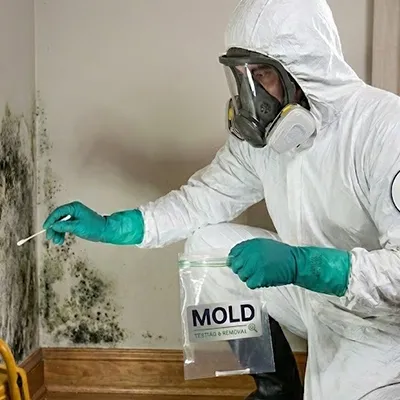
Checks moisture in walls, floors and ceilings with a pin meter and a thermal camera, photographs every finding, runs a calibrated air pump in the rooms of concern plus one outside as the control, and swabs or tape lifts any visible growth. Everything is logged with a chain of custody for the lab.
What is the difference between an air sample and a surface sample?
An air sample counts the spores floating in a room and compares them to outdoor air, which tells you whether the air is a problem and how bad. A surface sample identifies what is growing on a specific spot. Most visits use both.
Can I collect a sample myself and send it to you?
No. Accredited labs only accept samples taken by a licensed inspector with a documented chain of custody, and a report based on a self collected sample will not hold up with an insurer, a landlord or a buyer.
Cost and results
Clear prices, no quotes to chase, and what the report looks like.
How much does a mold test cost?
A base test is $400 and includes the inspection, two air samples or two surface samples, and the written report. Each additional sample is $75. Crawlspace or attic access adds $100. You get the price on the phone, not after the visit.
How many samples will I need?
Two covers most single concern visits: one in the room that worries you and one outside as the control. Add one per extra room you want checked. The inspector will tell you on site if an extra sample is worth it, and will tell you when it is not.
When do I get results?
Lab results and a plain English report within 48 hours of the visit, by email and text. Next day results are $100 extra and two day results are $50 extra.
What is in the report?
The lab data for every sample, the indoor versus outdoor comparison, photos and moisture readings from the inspection, where the moisture is coming from, and a short list of what to do next. If removal is needed it includes a written scope a remediation company can price from.
Can you tell me anything on the day?
Yes, the inspector will tell you what they saw and where moisture was high before they leave. Spore counts and species have to come from the lab, so the written answer follows within 48 hours.
Does the price include removal?
No, and that is on purpose. We are a mold testing company. Removal is quoted separately by a remediation partner, from our report, so the person telling you how bad it is never profits from the answer.
If we find mold
What happens next, who does the work, and how you know it is done.
Do you remove the mold too?
We are a mold testing company. When a report calls for removal, we refer you to a remediation partner we work with closely and stand 100% behind, and we support you and them together through the entire process. Because we never bid on the cleanup, our report is never a sales pitch.
Why not hire one company to test and remove?
Texas law requires the assessor and the remediator to be separate licensed companies, and we follow the same rule in Pennsylvania. The person who writes the report should not be the person paid to fix what it says.
What is a clearance test?
After the removal partner finishes, we come back, sample again and confirm the air and surfaces are back to normal before you release their final payment. The clearance report is the proof you keep.
Can I clean small mold myself?
A patch smaller than a bath towel on a hard surface like tile or a window frame is usually a cleaning job, and the report will say so. Anything on drywall, wood or insulation, anything larger, or anything that keeps coming back means the moisture source has to be fixed first, and that is where a partner comes in.
What if the test comes back clean?
Then you are done, and you have a dated report that says so. That is the answer for a lot of our calls, especially after a smell or a cough that turned out to be something else.
Health, insurance and paperwork
Who is at risk, what insurance covers, and the documents you may need.
Is mold dangerous?
It depends on the species, how much there is and who is breathing it. The common complaints are allergies, asthma flare ups, sinus problems, headaches and fatigue. Children, older adults, pregnant women and anyone with a weakened immune system react sooner. The test tells you what you are dealing with so you can decide with facts.
Is it "black mold"?
Black is a colour, not a species, and many harmless molds are black. The one people mean, Stachybotrys, needs a lab to identify. If it is there, the report says so by name and tells you what that means for your home.
Does homeowners insurance cover testing?
Sometimes, usually when the mold follows a sudden covered event like a burst pipe or storm damage, and rarely for slow leaks or humidity. Our report includes the photos, moisture readings and lab data an adjuster asks for, so it is worth a call to your carrier either way.
I am buying or selling a house. Does this help?
Yes. A dated independent report is the cleanest way to settle a mold question during a sale. Buyers use it to negotiate or walk away with confidence; sellers use a clean report to take the issue off the table.
My landlord says there is no mold. What can I do?
Get it tested. A report from an independent, licensed company gives you something a landlord, a housing office or a court will take seriously. We will send the report to both of you if you want.
Are you licensed and insured?
Yes. Texas Mold Assessment Consultant license MAC2189 covers Dallas and Fort Worth. Pennsylvania has no state mold license, so our Philadelphia inspectors are IICRC certified and every sample goes to an AIHA accredited lab. We are a BBB Accredited Business and fully insured.
Still have a question? Find your office and its number on the areas we serve page.
Ready to clear the air?
Call Philadelphia now or leave three details and we call you back within the hour, 7 days a week.
215-586-7368